
Primary Category: Business & Economy
Secondary Categories: Business & Technology Compliance, Business Growth & Strategy
Tags: Compliance Landscape Management, Business Compliance, IT Compliance, Privacy Compliance, Security Compliance, Corporate Compliance, Operational Compliance, Employment Compliance, Continuous Compliance
Author: FE Editorial Team
Estimated Reading Time: 8–10 Minutes
Published Date: 28-07-2026
Discover why Business and IT Compliance Management is essential for sustainable growth, operational resilience, customer trust, and long term business success.
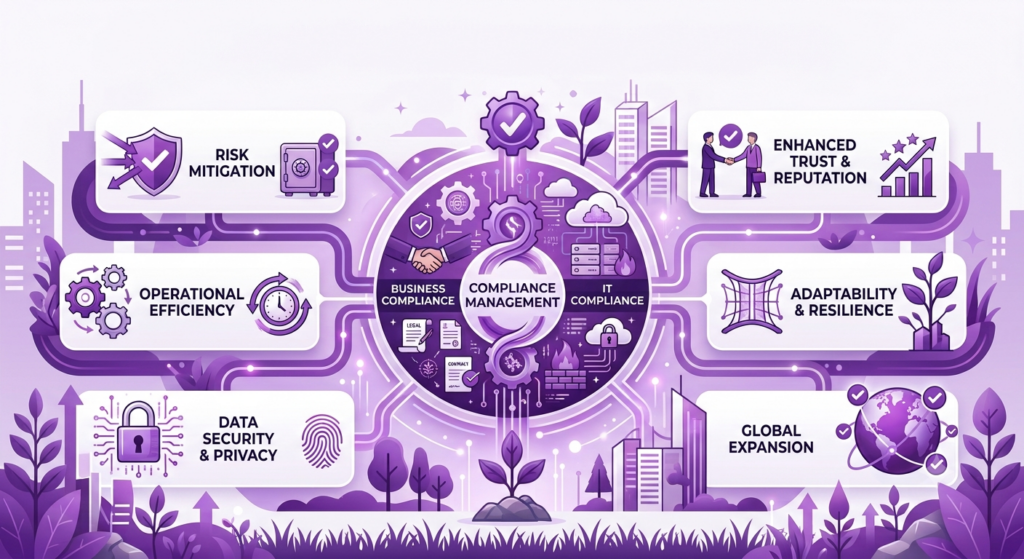
Business and IT Compliance Management shouldn’t be something you dust off only when regulations shift, a customer asks a hard question, or an audit lands on the calendar. As your business grows, so do your responsibilities across people, technology, data, and markets. Companies that manage this shifting landscape continuously build more trust, more resilience, and a sturdier foundation for growth.
Most business owners think of compliance as a box to check: a licence to renew, a policy to publish, a security control to install. That view worked fine for a smaller, simpler business. It doesn’t hold up anymore.
As the company grows, its obligations grow with it. You enter a new market, hire more people, adopt a cloud platform, sign a bigger client, bring on a new vendor. Each of these ordinary decisions can quietly reshape your corporate, employment, contractual, privacy, or technology obligations. Nothing about that landscape stays still for long.
That’s the real case for Business and IT Compliance Management, a continuous way of identifying, understanding, and adapting the obligations that come with running a growing organization not a once a year fire drill.
Done well, this isn’t extra bureaucracy. It’s the opposite. Effective compliance management gives your team clarity, cuts uncertainty, and keeps growth from quietly creating obligations nobody’s tracking.
Technology makes this even more pressing. Customer data moves through your sales platform, employee data through HR systems, supplier details through procurement tools. Privacy and cybersecurity aren’t IT’s problem alone anymore they’re everyone’s. This shift is reflected in the NIST Cybersecurity Framework 2.01, which places governance alongside technical controls, recognizing that cybersecurity risk is fundamentally a business risk.
For growing businesses, the goal isn’t to stack up more policies or certificates. It’s a proportionate, continuously improving approach one that lets you understand your responsibilities without slowing down the business. Handled this way,
- Compliance contributes to growth not through direct revenue
- But by strengthening trust
- Readiness for the next opportunity.
The Compliance Landscape Has Changed
Compliance used to be simple to picture:
- Register the company
- Keep the licences current
- Follow employment rules
- Protect the records.
For a small business in one market, that was manageable.
Modern businesses don’t operate that way. Employees work from multiple locations. Customer data sits in cloud tools. Vendors and service providers touch your systems from outside. Enterprise customers ask for security assessments before they’ll sign.
Take something as ordinary as adopting a new SaaS tool. It looks like a simple operational decision until you ask what information the provider receives, where it’s stored, who can access it, and what happens to it when the contract ends. None of this means you should avoid new technology. It means a single business decision can now touch several compliance obligations at once, which is exactly why Business and IT Compliance Management has become a connected discipline rather than a set of separate checklists.
Business and IT Compliance Management: Why the Two Have Merged
Companies traditionally split ownership neatly, HR handled employment, legal handled contracts, IT handled security. That division still works for assigning day-to-day responsibility, but it no longer reflects how work actually happens.
Look at something as routine as onboarding a new employee. HR owns the process, but IT provisions system access, management sets authority levels, and personal data gets collected and stored along the way. One HR task touches employment, privacy, and security simultaneously proof that the old departmental walls don’t match reality anymore.
| Business Activity | Business Compliance Angle | IT / Information Angle |
|---|---|---|
| Hiring an employee | Employment terms, policies | System access, employee data, security |
| Onboarding a customer | Contracts, confidentiality | Customer data, access, privacy requirements |
| Engaging a vendor | Contractual obligations | Third-party access, data processing |
| Adopting new software | Operational approval, ownership | Data storage, access controls, privacy |
| Remote working | Employment policies | Device security, identity, access |
| Entering a new market | Corporate, industry requirements | Data protection requirements |
A weak spot in one area tends to surface somewhere else. A poorly managed employee exit isn’t just an HR issue if that person still has system access. A new vendor isn’t purely a procurement decision if they touch confidential data.
What Compliance Landscape Management Actually Means
We define Compliance Landscape Management as the continuous process of identifying, assigning, maintaining, and improving the compliance responsibilities that apply to your business as it evolves corporate, employment, contractual, privacy, security, and technology, together.
The goal isn’t a large compliance department or tracking every regulation worldwide. It’s much more practical:
- Know what applies,
- Understand why
- Assign an owner
- Review it when something changes.
A policy built for twenty employees may not hold at two hundred. A security control designed for one office may need rethinking once your team goes remote. Your business changes so your compliance landscape changes with it.
It also helps to remember that compliance isn’t only about law. Regulatory requirements, industry standards, certifications, customer contracts, and internal policies are all different forms of obligation. Treating every one of them as legally mandatory leads to over-engineering; assuming nothing matters unless a law says so leads to real gaps. The right approach is proportionate to your actual risk, industry, and stage of growth.
Why This Is a Leadership Responsibility
Compliance work is distributed,
- HR manages employment policy
- IT manages access controls
- Commercial teams manage contracts.
But no single department can see the whole picture. That’s a leadership job. CEOs and senior leaders don’t need to become privacy or security specialists. Their responsibility is visibility:
- knowing what applies
- who owns it
- how the organization responds when things change.
That’s different from controlling every decision, which just slows the business down. Many compliance obligations start as ordinary business decisions, not regulatory notices. Winning a large enterprise customer is a sales win until due diligence requests security controls, confidentiality commitments, and audit rights, pulling in operations, HR, IT, and legal all at once. Leadership decisions shape the compliance landscape whether or not anyone labels them that way.
Culture matters here too. If managers routinely bypass policy to save time, employees learn compliance is optional. The healthier message: understand the requirement, follow the process, raise concerns early, and improve what isn’t working.
That doesn’t mean every decision needs to land on a leadership committee a better model is distributed ownership with leadership oversight. HR owns employment practices, IT owns access controls, commercial teams own contracts, and leadership’s job is to make sure those pieces stay connected as the business changes, not to sign off on every individual control
The Real Cost of Treating Compliance as a Periodic Exercise
For many companies, compliance gets attention only when a customer requests documentation, a contract renews, or an audit is scheduled. That works when a business is small and stable. As it grows, the gap between what leadership believes is compliant and what’s actually happening operationally can widen not from negligence, but because the business changed faster than its compliance practices did.
Consider a company chasing a major enterprise deal. Commercial discussions go well, then vendor due diligence begins. If policies are outdated or nobody can produce evidence confidently, onboarding slows and the problem stops being “compliance” and becomes a business readiness problem.
The same friction shows up internally. When reviews only happen occasionally, employees aren’t sure which process is current, access lists go stale, and small inconsistencies pile up into real inefficiency. Ironically, that bureaucratic feeling rarely comes from too much compliance it comes from compliance that never evolved alongside the business.
There’s also a trust cost. Customers, employees, and partners all extend trust based on how responsibly you handle information and commitments. A gap doesn’t automatically break that trust, but being unable to explain who owns a requirement or when it was last reviewed creates doubt even without an actual incident.
Compliance as a Growth Enabler, Not Just a Shield
Compliance usually gets framed defensively,
- Avoid penalties
- Pass the audit
- Meet the contract.
That’s real, but it’s half the story. Managed well, Business and IT Compliance Management also builds customer confidence, operational maturity, and readiness for the next opportunity. As a company grows, expectations from customers and partners grow too.
A small client signs a standard agreement and a large enterprise customer wants to know how you protect confidential data, manage vendor risk, and respond to incidents before they’ll sign anything. Organizations that can answer those questions clearly move faster through vendor onboarding and that speed often becomes a competitive edge.
The same logic applies to entering new markets or forming partnerships. Businesses with strong visibility into their compliance landscape don’t necessarily satisfy every requirement automatically, but they spot what needs to change earlier, which makes growth more deliberate and less reactive.
There’s an operational upside too. Good compliance practices have clear ownership, defined access, consistent onboarding and offboarding are also just good business practices. A clear joiner, mover, leaver process satisfies security requirements, but it also gets new employees productive faster and keeps former employees out of your systems. The compliance improvement and the operational improvement are often the same thing.
One important caution is that the growth shouldn’t mean more compliance for its own sake. A twenty person company doesn’t need a multinational’s governance structure, and not every new tool needs a full review. The goal is proportionate maturity, not maximum administration.
Employees benefit too. Unclear rules create uncertainty and excessive rules create frustration. Clear, proportionate guidance on how confidential information should be handled, which systems are approved, where to raise a concern lets people work confidently without leadership having to explain every process by hand. That consistency becomes more valuable, not less, as headcount grows.
From Checklist to Continuous Management
Moving from periodic compliance to continuous management doesn’t require a complex new framework. It can run as a simple, repeatable cycles,
| Stage | Practical Question |
|---|---|
| Identify | What requirements and commitments apply to us? |
| Assess | Where are we today, and what needs attention? |
| Assign | Who owns this? |
| Implement | What proportionate action is required? |
| Monitor | Is it still working as intended? |
| Review | Has something changed that affects it? |
| Improve | What’s the next small improvement? |
Not everything needs constant monitoring. What matters is spotting the right triggers a new enterprise customer, a critical vendor, a new market, a significant technology change and reviewing the relevant piece of your compliance landscape when they occur.
A few practical habits make this easier to sustain and keep compliance close to the business by reviewing access at onboarding and offboarding, building vendor questions into procurement, and assigning contract owners as agreements are signed. Maintain one simple register that answers six questions what applies, why, who owns it, what’s being done, when it was reviewed, and when it’s due again. A well-maintained spreadsheet beats an elaborate system nobody updates.
The FE Editorial Team Perspective
We see compliance as a business capability, not an administrative obligation. Organizations don’t get more resilient by adding policies they get more resilient when responsibilities are clear, decisions are made with awareness, and good practices become part of everyday operations.
We encourage a lean, continuous-improvement approach inspired by Kaizen for small, consistent adjustments in a process reviewed because the business changed, a policy simplified, an overlooked obligation assigned an owner tend to outperform big compliance overhauls undertaken only when circumstances force the issue.
Business and IT Compliance Management isn’t about creating more work. It’s about creating visibility, accountability, and confidence. Businesses that understand their responsibilities and keep improving them are better positioned to build trust, adapt to change, and grow sustainably because growth isn’t only about expansion. It’s about the ability to grow responsibly, with the confidence of the customers, employees, and partners who depend on you.