
Primary Category: Technology & Innovation
Secondary Categories: Business & Economy, Technology & Innovation, Business Growth & Strategy
Tags: Workflow Automation, AI Enablement, Intelligent Automation, Cross Platform Integration, Enterprise Automation, Business Process Automation, Digital Transformation, AI Orchestration, Enterprise Applications, Business Process Intelligence.
Author: FE Editorial Team
Estimated Reading Time: 11–12 Minutes
Published Date: 27-06-2026
Beyond Automation: How AI-Enabled Workflow Orchestration Is Transforming Cross-Platform Business Operations
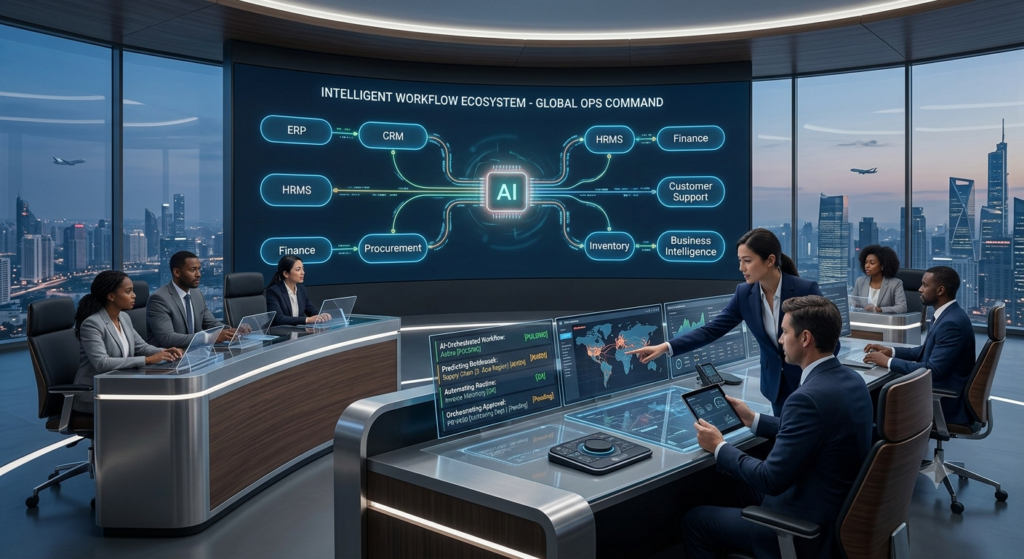
Organizations managing multiple business platforms are no longer asking whether to automate workflows they are asking how to orchestrate people, processes, data, and AI across increasingly complex digital ecosystems. Businesses that treat AI as a strategic operating capability rather than a standalone tool are better positioned to improve operational agility, reduce manual effort, and accelerate decision-making.
For many organizations, digital transformation has resulted in the adoption of multiple specialized business applications rather than a single unified platform. Enterprise Resource Planning (ERP) systems manage finance and operations, Customer Relationship Management (CRM) platforms support sales and customer engagement, Human Resource Management Systems (HRMS) streamline workforce administration, while procurement, inventory, project management, collaboration, and analytics platforms each play a critical role in day-to-day business activities.
Individually, these systems deliver significant business value. Collectively, however, they often create a fragmented operating environment where information is duplicated, workflows become disconnected, and employees spend considerable time coordinating processes instead of driving business outcomes.
Traditional workflow automation has helped organizations eliminate repetitive manual tasks, improve consistency, and increase operational efficiency. Yet as businesses continue to scale, automation alone is no longer sufficient. Modern enterprises require intelligent coordination across departments, applications, and business processes—an approach increasingly known as AI-enabled workflow orchestration.
Unlike conventional automation, which focuses on predefined tasks, AI-enabled workflow orchestration introduces contextual decision-making, predictive intelligence, and real-time coordination across multiple business platforms. It enables organizations to connect systems, streamline complex workflows, reduce operational silos, and empower employees with actionable insights rather than simply replacing manual effort.
According to IBM, workflow orchestration extends beyond task automation by coordinating applications, services, people, and automated processes into a unified end-to-end workflow. This orchestration layer provides greater operational visibility, improves process consistency, and enables organizations to manage increasingly complex business environments more effectively.1
For business leaders, this shift represents more than another technology investment. It marks a fundamental evolution in how organizations operate, collaborate, and make decisions. As artificial intelligence becomes more deeply embedded within enterprise operations, organizations that successfully orchestrate their people, processes, and digital platforms will be better positioned to improve productivity, enhance customer experiences, and sustain long-term competitive advantage.
This article explores how AI-enabled workflow orchestration is transforming cross-platform business operations, the business value it delivers, practical implementation considerations, and why it is rapidly becoming a strategic capability for organizations preparing for the next generation of digital transformation.
The New Business Reality
Business operations have undergone a remarkable transformation over the past decade. Organizations no longer rely on a single software platform to manage their operations. Instead, they operate within a growing ecosystem of specialized applications, each designed to solve a specific business challenge.
A typical mid-sized enterprise may simultaneously use an ERP platform for finance and procurement, a CRM application for customer engagement, HR software for workforce management, separate inventory systems, project management tools, collaboration platforms, cloud storage solutions, business intelligence dashboards, and numerous industry-specific applications. Each platform performs its intended role effectively. The challenge arises when these platforms need to work together.
Imagine a customer placing an order with a manufacturing company. The sales representative records the opportunity in the CRM system. Finance verifies customer credit through the ERP platform. Inventory systems check product availability while procurement evaluates replenishment requirements. Warehouse operations schedule dispatch, logistics teams coordinate delivery, customer service prepares communication updates, and executive dashboards monitor the entire transaction.
Although every department performs its responsibilities independently, the customer experiences the organization as a single business. Any delay, inconsistency, or communication gap between these systems immediately affects service quality.
This growing dependence on multiple interconnected applications has fundamentally changed how organizations think about operational efficiency. Business leaders are no longer asking whether individual departments can automate repetitive tasks. Instead, they are asking a far more strategic question:
How can the entire organization operate as one connected ecosystem, regardless of how many applications or departments are involved?
The answer increasingly lies in workflow orchestration rather than workflow automation.
Research published by McKinsey & Company2 suggests that organizations create significantly greater value from artificial intelligence when they redesign end-to-end business processes instead of simply embedding AI into existing workflows. Rather than automating isolated activities, leading organizations are rethinking how people, technology, and business processes interact across the enterprise to improve productivity, responsiveness, and decision-making.
This shift reflects a broader change in enterprise thinking. Technology is no longer viewed as a collection of independent business systems. It is becoming the operational fabric that connects employees, customers, suppliers, partners, and decision-makers through intelligent, integrated workflows. For organizations experiencing rapid growth, this evolution is particularly important.
As businesses expand into new markets, introduce additional products and services, recruit larger teams, or operate across multiple locations, the complexity of managing disconnected applications increases exponentially. Manual coordination that once worked for a twenty-person organization quickly becomes unsustainable for a company managing hundreds of employees, multiple departments, and thousands of daily transactions.
Artificial Intelligence introduces a new opportunity. Rather than replacing employees or existing enterprise applications, AI enables organizations to make those systems work together more intelligently. It can analyze operational patterns, identify process bottlenecks, recommend actions, prioritize work, and assist employees in making faster, better-informed decisions—all while allowing existing business applications to continue performing their specialized functions.
This evolution marks the beginning of a new operating model. One where business success is determined not simply by how many systems an organization owns, but by how effectively those systems collaborate to deliver value.
Why Traditional Workflow Automation Is No Longer Enough
For more than two decades, workflow automation has played a central role in improving business efficiency. Organizations automated repetitive activities such as invoice approvals, employee onboarding, leave requests, purchase requisitions, customer notifications, and document routing to reduce manual effort and improve operational consistency. These initiatives delivered measurable benefits.
Employees spent less time performing repetitive administrative tasks, approval cycles became faster, compliance improved, and organizations reduced operational costs through standardized processes. Workflow automation became an essential component of digital transformation strategies across industries.
However, today’s business environment is fundamentally different from the one in which traditional workflow automation was first introduced.
Business operations are no longer confined to individual departments or isolated software applications. Modern organizations operate within interconnected digital ecosystems where information flows continuously between finance, procurement, sales, customer service, human resources, supply chain, compliance, and executive management. As businesses expand, the limitations of traditional automation become increasingly apparent.
Consider a procurement approval process. In a conventional workflow, an employee submits a purchase request, the manager approves it, finance validates the budget, procurement issues the purchase order, and the supplier receives confirmation. Each step follows predefined business rules and progresses in sequence. While efficient for a single departmental process, this workflow often lacks visibility into the broader business context.
For example:
- Has the supplier’s performance declined over the past six months?
- Is inventory already available in another warehouse?
- Does the requested purchase align with current sales forecasts?
- Are there alternative vendors offering better commercial terms?
- Will this expenditure affect cash flow during the current reporting period?
Traditional automation cannot independently evaluate these questions because it executes predefined instructions rather than interpreting business context. This distinction represents the fundamental difference between automation and intelligent orchestration.
Automation focuses on executing tasks. Orchestration focuses on optimizing business outcomes.
According to IBM, workflow orchestration1 coordinates multiple automated tasks, applications, systems, and services into a unified end-to-end business process. Instead of treating each workflow independently, orchestration enables organizations to manage complete operational journeys that span departments, technologies, and business functions. This integrated approach provides greater operational visibility while reducing delays caused by disconnected systems and manual coordination.
Another important limitation of traditional automation is its dependence on static business rules.
Rules are valuable because they establish consistency. However, business environments rarely remain static.
- Customer expectations evolve.
- Market conditions change.
- Supply chain disruptions occur unexpectedly.
- Regulatory requirements are updated.
- New business models emerge.
- Organizations enter new geographic markets.
- Business priorities shift.
Static workflows often require extensive manual redesign every time these changes occur, slowing organizational responsiveness precisely when agility is most needed. Artificial Intelligence introduces an additional layer of adaptability.
Rather than relying exclusively on predefined rules, AI can evaluate multiple sources of business information simultaneously, recognize operational patterns, identify anomalies, recommend next-best actions, and continuously improve decision support based on historical outcomes.
This capability transforms workflow automation from a reactive operational tool into a proactive business capability.
Research from Deloitte3 highlights that organizations are increasingly moving beyond isolated automation initiatives toward intelligent operations where AI, data, and business processes work together to improve decision-making, operational resilience, and enterprise-wide performance. Organizations that successfully integrate AI into operational workflows are better positioned to respond to changing business conditions while maintaining efficiency across increasingly complex operating environments.
For business leaders, the conversation is therefore changing.
The question is no longer:
“Which tasks should we automate?”
Instead, organizations are asking:
“How can every department, every business application, and every decision work together as one intelligent operating model?”
That question defines the next stage of digital transformation. It is no longer about automating individual processes. It is about orchestrating the entire business.
Traditional Workflow Automation vs. AI-Enabled Workflow Orchestration
| Business Capability | Traditional Workflow Automation | AI-Enabled Workflow Orchestration |
|---|---|---|
| Primary Objective | Automate repetitive tasks | Optimize end-to-end business processes |
| Decision Logic | Rule-based | Context-aware and data-driven |
| Business Scope | Individual departments | Enterprise-wide operations |
| System Integration | Limited | Cross-platform coordination |
| Adaptability | Requires manual updates | Learns from operational patterns and changing business conditions |
| Human Role | Task execution and approvals | Strategic decision-making supported by AI |
| Business Visibility | Departmental reporting | Unified operational visibility across the enterprise |
| Long-Term Value | Improved efficiency | Operational agility, resilience, and continuous optimization |
Understanding AI-Enabled Workflow Orchestration
The term AI enabled workflow orchestration has gained significant attention as organizations accelerate their digital transformation initiatives. While it is often associated with artificial intelligence, automation, or enterprise integration, workflow orchestration represents something much broader.
At its core, workflow orchestration is about ensuring that people, business processes, enterprise applications, and data work together as one coordinated system.
Think of an orchestra. An orchestra is not simply a collection of talented musicians. Every musician performs a specific role, yet the quality of the performance depends on how effectively they perform together under the guidance of a conductor.
Modern businesses operate in much the same way. Finance, Sales, Human Resources, Procurement, Operations, Customer Service, Warehousing, and Executive Management each perform specialized functions. Likewise, ERP platforms, CRM applications, HRMS solutions, accounting software, collaboration tools, and business intelligence systems each serve a distinct purpose.
“Individually, they perform well. Collectively, however, they often operate independently.”
Workflow orchestration acts as the conductor, ensuring that every department, every application, and every business process contributes to a common operational objective. Artificial Intelligence strengthens this coordination by introducing intelligence into the orchestration layer. Instead of simply moving information from one system to another, AI can analyse business context, recognize operational patterns, prioritize activities, recommend next-best actions, and support employees in making more informed decisions.
This transforms workflows from static sequences into adaptive business processes capable of responding to changing operational conditions. According to Microsoft4, organizations are increasingly moving towards AI-powered business process orchestration, where intelligent agents assist employees by coordinating tasks across enterprise applications, improving productivity, and reducing the administrative burden associated with repetitive operational activities.
Moving Beyond System Integration
Many organizations believe workflow orchestration is simply another form of system integration. While integration remains an important foundation, orchestration serves a much broader purpose.
“Integration focuses on connecting applications and Orchestration focuses on coordinating business operations.”
For example, integrating an ERP system with a CRM platform enables customer information to flow between applications. Workflow orchestration determines when that information should move, who should receive it, which business rules apply, what approvals are required, and how exceptions should be handled if business conditions change. The distinction may appear subtle. Operationally, however, it has a profound impact. Organizations no longer manage software. They manage complete business outcomes.
A Practical Business Scenario
- Consider a growing manufacturing company supplying products across multiple regions.
- A customer places an order through the company’s sales team.
- The CRM records the opportunity.
- The ERP validates pricing, taxes, and customer credit.
- Inventory systems verify product availability across multiple warehouses.
- If stock levels fall below predefined thresholds, procurement initiates replenishment activities.
- Finance evaluates payment terms.
- Warehouse teams prepare dispatch schedules.
- Logistics providers receive shipping instructions.
- Customer service automatically receives estimated delivery information.
- Executive dashboards update operational performance in real time.
- Each department continues using its preferred business application.
No employee needs to manually transfer information between systems. No department waits for emails requesting status updates. Decision-makers receive accurate operational visibility without requesting reports from multiple teams. Employees focus on resolving business issues rather than coordinating software applications.
This is not because every activity has been automated. It is because every activity has been intelligently orchestrated.
Artificial Intelligence Changes the Nature of Business Decisions
Traditional workflow automation performs predefined activities consistently. Artificial Intelligence introduces reasoning.
Rather than asking employees to investigate every operational exception, AI can identify unusual purchasing behaviour, detect inventory anomalies, recognise supplier performance trends, highlight customer payment risks, and recommend corrective actions before issues begin affecting business operations.
For example, if a supplier consistently delivers materials later than agreed, AI may recommend alternative suppliers based on historical performance, procurement policies, delivery reliability, and commercial agreements.
Similarly, if customer demand unexpectedly increases, AI can prioritise production schedules, identify inventory shortages, and notify procurement teams before shortages disrupt fulfilment.
The objective is not to replace business managers. It is to provide them with timely, relevant, and actionable information that supports faster and more confident decision-making. This collaborative approach is becoming increasingly important as organizations manage growing volumes of operational data across multiple business systems.
Research published by IBM highlights5 that enterprise AI delivers the greatest value when it augments human decision-making rather than attempting to replace it. Organizations combining AI-driven insights with human expertise are better positioned to improve operational efficiency while maintaining governance and accountability.
Human Expertise Remains Central
One of the most common misconceptions surrounding AI-enabled workflow orchestration is that intelligent automation removes people from business processes. In reality, successful implementations achieve precisely the opposite. They reduce repetitive administrative activities while allowing employees to concentrate on higher-value responsibilities such as customer engagement, supplier relationships, strategic planning, innovation, and problem solving. Approvals involving financial risk, regulatory compliance, contractual obligations, or strategic business decisions continue to require human judgment.
Artificial Intelligence provides recommendations. Business leaders make decisions.
This balance between intelligent technology and experienced professionals creates an operating environment where organizations become more agile without compromising governance, accountability, or business ethics.
As Harvard Business Review6 has observed in discussions on enterprise AI adoption, organizations achieve the strongest outcomes when AI complements human expertise rather than replacing it. The emphasis is increasingly on redesigning work so that technology enhances decision-making, collaboration, and business performance.
Technology Should Support Business Strategy
Perhaps the most important lesson for business leaders is that workflow orchestration should never begin with technology selection. It should begin with business objectives.
Organizations seeking to improve customer experiences, accelerate growth, strengthen compliance, improve operational visibility, or increase workforce productivity should first understand how work flows across the enterprise. Only then should they determine where automation, artificial intelligence, and enterprise applications can deliver measurable business value.
Technology alone does not transform organizations. Well-designed business processes, supported by capable people and intelligent technology, create sustainable competitive advantage.
System Integration vs. AI-Enabled Workflow Orchestration
| Aspect | System Integration | AI-Enabled Workflow Orchestration |
|---|---|---|
| Primary Purpose | Connect business applications | Coordinate complete business operations |
| Focus | Data exchange | Business outcomes |
| Decision Support | Limited | AI-assisted recommendations |
| Scope | Individual integrations | Enterprise-wide workflows |
| Business Context | Static | Dynamic and context-aware |
| Human Role | Monitor system connections | Collaborate with AI for informed decision-making |
| Long-Term Value | Operational connectivity | Intelligent enterprise operations |
The Challenge of Cross-Platform Business Operations
Business growth is often measured by increased revenue, expanded customer bases, new markets, and larger teams. However, behind every successful growing organization lies another reality that receives far less attention the steady increase in operational complexity.
As organizations evolve, they naturally adopt new business applications to solve specific operational needs. Finance teams implement Enterprise Resource Planning (ERP) systems to manage accounting and procurement. Sales teams rely on Customer Relationship Management (CRM) platforms to strengthen customer engagement. Human Resources deploy Human Resource Management Systems (HRMS) to manage workforce operations, while inventory, logistics, project management, collaboration, customer support, and analytics platforms are introduced as business requirements expand.
Each investment delivers value independently. Collectively, however, they often create an environment where business information becomes fragmented across multiple systems. This fragmentation rarely occurs because technology has failed. It occurs because every application is designed to optimize a specific business function rather than the organization as a whole. Over time, the number of systems increases, business processes become more interconnected, and employees spend an increasing amount of time navigating technology instead of serving customers or improving operations.
When Business Systems Stop Talking to Each Other
Imagine a trading company that imports industrial equipment from multiple international suppliers while serving customers across several regions.
- A customer confirms an order.
- The sales team updates the CRM.
- Finance verifies payment terms through the ERP.
- Procurement checks supplier commitments.
- Warehouse teams verify inventory availability.
- Logistics coordinates shipment schedules.
- Customer support prepares delivery updates.
- Executive management expects real-time visibility throughout the process.
Each department completes its responsibilities using its preferred application. The challenge begins when information must move between these systems. If inventory data is delayed, procurement may place unnecessary purchase orders. If finance receives outdated customer information, invoice approvals slow down. If logistics cannot access current warehouse updates, delivery schedules become unreliable.
Customer service often becomes the first department to receive complaints, even though the issue originated elsewhere within the organization. None of these departments are operating incorrectly. The business process itself has become disconnected. This situation is increasingly common among organizations that have grown organically over several years, adopting new software whenever immediate operational requirements emerged.
According to Deloitte3, many enterprises now manage increasingly complex technology environments where multiple digital platforms coexist. The challenge is no longer selecting the right technology but enabling these systems to work together intelligently to improve enterprise-wide decision-making and operational agility.
The Hidden Cost of Operational Silos
Operational silos are often discussed in terms of organizational culture. In reality, technology silos can create equally significant business challenges. When departments operate using disconnected systems, organizations begin experiencing hidden operational costs that rarely appear on financial statements. Business leaders may observe:
- Managers requesting reports from multiple departments before making decisions.
- Employees manually transferring information between applications.
- Duplicate customer or supplier records.
- Multiple versions of the same business data.
- Delayed approvals caused by missing information.
- Increased dependency on emails and spreadsheets for coordination.
- Difficulty identifying the source of operational issues.
These activities may appear minor when viewed individually. Collectively, however, they consume hundreds of productive hours each month while increasing the likelihood of human error. More importantly, they reduce organizational agility. Instead of responding quickly to customers and market opportunities, businesses spend valuable time reconciling information across disconnected systems.
McKinsey & Company2 notes that organizations achieve greater value from AI when they redesign business processes around integrated workflows rather than simply automating isolated activities. End-to-end process transformation creates significantly greater business impact than optimizing individual departmental tasks.
Complexity Grows Faster Than Headcount
One of the most common misconceptions among growing businesses is that operational complexity increases in direct proportion to the number of employees. In practice, complexity often grows much faster than workforce size.
A company with twenty employees may operate comfortably using three or four business applications. By the time the organization reaches two hundred employees, it may rely on dozens of interconnected systems supporting finance, procurement, sales, marketing, customer service, logistics, compliance, cybersecurity, collaboration, reporting, and executive decision-making.
Each additional platform introduces new data flows, approval processes, security requirements, integrations, and reporting expectations. Without a coordinated operational strategy, complexity begins to scale faster than the business itself. This is why many organizations experience a noticeable slowdown during periods of rapid growth.
- Employees become busier.
- Managers attend more meetings.
- Reports become increasingly detailed.
- Decision-making takes longer.
Yet overall productivity improves only marginally. The issue is rarely employee capability. It is the growing complexity of managing disconnected business operations.
Why Business Leaders Should Think Beyond Software
Many digital transformation initiatives begin with selecting new technology.
- Should the organization invest in a new ERP?
- Should it replace the CRM?
- Should it implement another automation platform?
These are important decisions. However, they often address individual technology requirements rather than the broader business operating model.
Successful organizations increasingly recognize that sustainable digital transformation is not achieved by purchasing more software. It is achieved by improving how existing technology, people, and business processes work together.
Artificial Intelligence plays an important role in this transformation—not because it replaces existing enterprise systems, but because it helps coordinate them more intelligently. Rather than introducing another layer of operational complexity, AI-enabled workflow orchestration enables organizations to unify business processes across multiple platforms while providing employees with timely insights and decision support.
The result is not simply faster automation. It is a more connected, responsive, and resilient business capable of adapting to changing market conditions with greater confidence.
Common Cross-Platform Operational Challenges
| Business Function | Common Challenge | Business Impact |
|---|---|---|
| Sales & CRM | Customer information differs across systems | Reduced customer experience and delayed follow-ups |
| Finance | Manual reconciliation between ERP and operational systems | Reduced customer experience and delayed follow-ups |
| Procurement | Manual reconciliation between ERP and operational systems | Increased procurement costs and duplicate purchasing |
| Inventory & Warehousing | Manual reconciliation between ERP and operational systems | Stock shortages or excess inventory |
| Customer Support | Lack of access to operational updates | Delayed responses and lower customer satisfaction |
| Executive Management | Multiple reports from disconnected systems | Slower decision-making and limited business visibility |
Business Benefits Beyond Automation
For many years, organizations evaluated automation initiatives primarily through a single lens cost reduction. If repetitive tasks could be completed faster, with fewer manual interventions and lower operational costs, the initiative was considered successful. While efficiency remains important, today’s business leaders expect significantly more from their technology investments.
Modern organizations operate in environments characterized by rapidly changing customer expectations, global supply chains, distributed workforces, increasing regulatory requirements, and intense competitive pressure. In such an environment, simply automating repetitive tasks is no longer sufficient.
Businesses need operational intelligence. They need technology that helps employees make better decisions, collaborate more effectively, and respond to change with greater confidence. This is where AI enabled workflow orchestration begins delivering value beyond traditional automation.
Rather than focusing exclusively on task execution, it enables organizations to improve the quality of business operations across the enterprise.
Better Decision-Making Through Connected Information
One of the greatest challenges facing business leaders today is not a lack of data. It is the overwhelming volume of disconnected information spread across multiple business systems.
- Sales teams analyse CRM dashboards.
- Finance reviews ERP reports.
- Operations monitor inventory systems.
- Human Resources evaluate workforce metrics.
- Customer service manages support platforms.
- Each department possesses valuable information.
- Very few organizations possess a unified operational picture.
AI enabled workflow orchestration changes this dynamic by bringing together information from multiple enterprise systems and presenting it within the context of business decisions. Instead of asking managers to collect reports from different departments, intelligent workflows can provide relevant operational insights at the moment decisions are being made.
For example, a procurement manager approving a high-value purchase may automatically receive supplier performance history, current inventory levels, projected customer demand, budget availability, and delivery risks without accessing multiple applications separately.
The objective is not to replace managerial judgement. It is to ensure that decisions are supported by complete and timely business information.
According to IBM, enterprise AI7 creates the greatest business value when it augments human expertise by delivering actionable insights within existing business processes rather than requiring employees to search for information across multiple systems.
Improving Customer Experience Without Increasing Complexity
Customers rarely judge organizations by the quality of their internal systems. They judge them by the speed, consistency, and reliability of every interaction.
Whether placing an order, requesting support, or seeking information, customers expect organizations to respond quickly and accurately regardless of which department handles the request.
Unfortunately, disconnected business systems often make this difficult.
- A customer service representative may not immediately know whether an invoice has been processed.
- Sales teams may be unaware of delivery delays.
- Finance may not have visibility into customer support commitments.
- Warehouse teams may not know that a priority customer requires expedited dispatch.
Although every department performs its responsibilities effectively, the customer experiences unnecessary delays because information is fragmented.
AI enabled workflow orchestration reduces these communication gaps by enabling relevant business information to move intelligently across departments, allowing employees to respond with greater confidence and consistency. This improves customer experience without requiring organizations to replace their existing technology investments.
Microsoft8 highlights that organizations adopting AI within their business processes are increasingly focusing on improving employee productivity and customer outcomes simultaneously, enabling teams to spend more time delivering value and less time coordinating systems.
Building Operational Agility
Business conditions can change rapidly. A supplier may unexpectedly suspend production. Demand for a product may increase significantly. New regulatory requirements may be introduced. Economic conditions may influence purchasing behaviour.
Organizations that rely heavily on manual coordination often struggle to respond quickly because every operational adjustment requires multiple departments to exchange information before action can be taken. AI enabled workflow orchestration enables organizations to identify operational changes earlier, notify relevant stakeholders automatically, and recommend appropriate actions based on predefined business objectives.
Rather than waiting for problems to become visible through monthly reports, leaders gain earlier visibility into operational trends as they develop. This allows organizations to become more proactive rather than reactive.
Recent research from the World Economic Forum10 suggests that organizations are moving beyond isolated AI initiatives towards enterprise-wide transformation, where artificial intelligence is embedded into core workflows, decision-making processes, and operating models. The emphasis is no longer on deploying AI tools independently, but on redesigning how people, processes, and technology collaborate to deliver measurable business value.
Supporting Employees Rather Than Replacing Them
Discussions surrounding Artificial Intelligence frequently focus on automation replacing human work. In practice, organizations are discovering a different reality.
The greatest value often comes from reducing administrative burden rather than eliminating roles. Employees spend considerable time searching for documents, following up on approvals, transferring information between applications, preparing reports, and coordinating routine activities. These responsibilities are necessary. They are rarely where employees create the greatest business value.
AI enabled workflow orchestration allows professionals to devote more attention to customer relationships, innovation, strategic planning, supplier collaboration, and business improvement while repetitive coordination activities occur automatically in the background.
Harvard Business Review9 has argued that organizations achieve stronger business outcomes when Artificial Intelligence complements human capabilities instead of attempting to replace them. Human judgement, creativity, and relationship management remain central to effective decision-making, while AI strengthens analytical and operational capabilities.
Business Value Extends Beyond Technology
Perhaps the most significant benefit of AI enabled workflow orchestration is that it changes how organizations operate rather than simply how technology functions.
- It encourages departments to collaborate more effectively.
- It enables leaders to make faster, better-informed decisions.
- It improves operational transparency.
- It strengthens governance.
- It increases organizational resilience.
Most importantly, it allows growing businesses to scale without allowing operational complexity to grow at the same pace. Technology becomes an enabler of business strategy rather than another operational challenge to manage.
| Business Objective | Operational Improvement | Strategic Outcome |
|---|---|---|
| Faster Decision-Making | Unified operational visibility | Better executive decisions |
| Improved Customer Experience | Connected business processes | Higher customer satisfaction |
| Workforce Productivity | Reduced manual coordination | More value-added work |
| Operational Efficiency | Automated cross-platform workflows | Lower operational delays |
| Risk Management | Real-time monitoring and alerts | Stronger governance and compliance |
| Business Growth | Scalable operational model | Sustainable enterprise expansion |
Real-World Enterprise Use Cases: Where AI-Enabled Workflow Orchestration Creates Business Value
Understanding the benefits of AI enabled workflow orchestration is only part of the journey. The next question every business leader asks is simple,
“Where can we actually use it in our business?”
The answer depends less on the industry and more on how information flows across the organization. Whether a company operates in manufacturing, trading, retail, logistics, hospitality, construction, or professional services, the underlying challenge is remarkably similar. Business processes rarely begin and end within a single department. Every customer order, procurement request, employee onboarding process, or financial approval typically passes through multiple teams, applications, and decision makers before reaching completion.
This is precisely where AI enabled workflow orchestration creates measurable business value.
Finance: Accelerating Decisions Without Compromising Governance
Finance departments process thousands of transactions every month, from purchase requests and supplier invoices to customer payments and expense claims.
Traditionally, these activities require employees to verify documents, compare records across multiple systems, request approvals, and follow up with different departments before transactions can be completed. For growing organizations, these manual activities gradually become operational bottlenecks.
AI enabled workflow orchestration changes this by bringing together relevant business information before a decision is made.
Imagine a supplier invoice arriving in the finance system. Instead of waiting for employees to manually validate the purchase order, goods receipt, budget availability, and approval hierarchy, the orchestration layer can collect this information automatically from the ERP, procurement platform, warehouse records, and finance policies.
If everything matches predefined business policies, the invoice proceeds for approval with all supporting information already available. If discrepancies are identified, the appropriate stakeholders receive contextual alerts highlighting exactly where attention is required.
Employees spend less time collecting information and more time resolving genuine business exceptions.
According to IBM, enterprise AI7 delivers the greatest operational value when it augments existing business processes by providing context-aware insights that improve decision-making rather than simply automating isolated tasks.
Customer Service: Delivering Faster and More Consistent Experiences
Customers rarely know which department is responsible for resolving an issue. They simply expect accurate information and timely responses.
Imagine a customer calling to enquire about an order.
- The support representative often needs information from multiple systems.
- Has payment been received?
- Has production started?
- Has inventory been allocated?
- Has the shipment been dispatched?
- Has the logistics partner confirmed delivery?
In many organizations, obtaining these answers involves contacting different departments or switching between multiple applications. With AI enabled workflow orchestration, relevant information can be consolidated into a single operational view.
Instead of asking the customer to “wait while I check with another department,” employees receive real-time updates from connected business systems, allowing them to provide faster, more confident responses. The result is not only improved customer satisfaction but also reduced internal coordination.
Microsoft8 emphasizes that organizations are increasingly adopting AI to empower employees with contextual information, enabling them to respond more effectively while improving customer experiences.
Human Resources: Simplifying Employee Journeys
Employee onboarding often appears straightforward on paper. In reality, it involves numerous coordinated activities.
Once a candidate accepts an offer, HR must initiate documentation, IT prepares user accounts and equipment, finance updates payroll records, administration arranges workplace resources, managers prepare induction plans, and compliance teams verify regulatory requirements. Each department completes only a small part of the overall process.
Without effective coordination, delays become inevitable. AI enabled workflow orchestration enables these activities to progress simultaneously rather than sequentially. As one task is completed, the next stakeholders are automatically notified, relevant information is shared securely, and progress becomes visible across departments.
The experience improves not only for employees but also for the teams responsible for managing the onboarding process.
Procurement and Supply Chain: Responding Faster to Business Changes
Procurement decisions are no longer influenced solely by pricing. Supplier reliability, inventory availability, transportation schedules, production forecasts, contractual obligations, and customer demand all influence purchasing decisions. Imagine receiving an urgent customer order for a high demand product. Before approving additional purchases, procurement leaders need answers to several questions.
- Is inventory already available at another warehouse?
- Are existing supplier commitments sufficient?
- Can production schedules be adjusted?
- Will the purchase affect current budgets?
- Are alternative suppliers available?
Gathering this information manually can delay decision-making. AI enabled workflow orchestration enables procurement teams to access operational insights from multiple business systems within a single workflow, helping them make faster and more informed decisions.
According to McKinsey & Company2, organizations generate greater value from AI when they redesign end-to-end business processes rather than limiting AI to isolated operational tasks. This approach improves responsiveness and supports more resilient decision-making across the enterprise.
Executive Leadership: Seeing the Bigger Picture
Perhaps the greatest beneficiaries of AI enabled workflow orchestration are business leaders themselves.
- Executives rarely struggle because information does not exist.
- They struggle because information exists in too many places.
- Sales reports tell one story.
- Finance presents another.
- Operations highlight different priorities.
- Customer service identifies additional concerns.
- Decision making becomes slower because leadership teams spend valuable time reconciling information before discussing solutions.
AI enabled workflow orchestration creates a connected operational environment where business information flows continuously across departments, providing leadership with a more complete and timely view of organizational performance. Rather than replacing executive judgement, AI strengthens it by reducing uncertainty and improving visibility. This allows leadership teams to focus on strategic decisions instead of operational coordination.
Business Functions and Opportunities for AI-Enabled Workflow Orchestration
| Business Function | Traditional Challenge | AI Orchestrated Outcome |
|---|---|---|
| Finance | Manual invoice validation and approvals | Context-aware financial workflows with faster approvals |
| Customer Service | Information spread across multiple systems | Unified customer information and quicker responses |
| Human Resources | Sequential onboarding activities | Parallel, coordinated onboarding across departments |
| Procurement | Manual supplier and inventory verification | Intelligent purchasing recommendations and improved visibility |
| Supply Chain | Disconnected logistics and inventory updates | Realtime coordination across procurement, warehousing, and logistics |
| Executive Management | Fragmented reporting from multiple departments | Connected operational insights supporting faster decision making |
The Future of Connected Business Operations
Business technology continues to evolve at an unprecedented pace. Organizations that once focused on digitizing individual processes are now working toward creating fully connected business ecosystems where information moves seamlessly across departments, applications, and decision-makers.
Artificial Intelligence is accelerating this transformation. However, the future of enterprise operations is unlikely to be defined by organizations that simply deploy more AI tools.
Instead, success will belong to organizations that create intelligent operating environments where technology supports collaboration, business processes adapt to changing conditions, and employees receive timely insights that improve decision-making. This represents an important shift in business thinking.
For many years, organizations viewed enterprise applications as individual systems solving individual business problems. Today, those same applications are becoming interconnected components of a much larger operational ecosystem.
- ERP systems continue managing finance.
- CRM platforms continue strengthening customer relationships.
- HRMS solutions continue supporting workforce operations.
- Supply chain platforms continue coordinating logistics.
- Business intelligence systems continue analysing performance.
The difference is that these systems are no longer expected to operate independently. Increasingly, they are expected to collaborate.
According to the World Economic Forum11, organizations are moving toward enterprise-wide transformation where Artificial Intelligence becomes embedded within business operations rather than existing as isolated technology initiatives. Competitive advantage increasingly depends on how effectively organizations redesign workflows, decision-making, and collaboration across their entire operating model.
For growing businesses, this creates an important opportunity. Many organizations already possess the technology needed to improve operational performance. The challenge is no longer acquiring additional software. The challenge is enabling existing business applications, business processes, and employees to work together more intelligently.
AI enabled workflow orchestration offers a practical path toward achieving that objective. It enables organizations to connect information, improve visibility, reduce operational friction, and strengthen collaboration without fundamentally replacing existing enterprise investments.
As organizations continue expanding across markets, locations, and digital platforms, connected business operations will increasingly become a competitive differentiator rather than simply an operational improvement. Businesses that successfully orchestrate people, processes, data, and enterprise applications will be better positioned to respond to changing market conditions, improve customer experiences, and build sustainable operational resilience for the future.
FE Editorial Team Perspective
Digital transformation has never been solely about technology—it has always been about improving how businesses operate, collaborate, and create value.
For many organizations, the first phase of transformation focused on digitizing individual departments. The next phase introduced workflow automation to eliminate repetitive tasks and improve operational efficiency. Today, businesses are entering a new stage of enterprise transformation where success depends not on how many applications an organization owns, but on how effectively those applications, people, and processes work together. This is where AI enabled workflow orchestration becomes increasingly relevant.
From the perspective of the FE Editorial Team, organizations rarely struggle because they lack technology. More often, they struggle because business information is fragmented, operational processes evolve independently, and enterprise applications operate in isolation. As businesses grow, these disconnects gradually reduce agility, slow decision-making, and create unnecessary operational complexity.
AI enabled workflow orchestration addresses this challenge by shifting the conversation from individual systems to connected business outcomes. Rather than introducing another layer of technology, it enables organizations to make better use of the technology they already have by creating intelligent coordination across departments, workflows, and business functions.
The greatest value of Artificial Intelligence will not come from replacing people or automating every decision. It will come from helping organizations remove operational friction, strengthen collaboration, and provide employees with the right information at the right time to make informed business decisions.
For growing enterprises, this represents an opportunity to build a more resilient operating model one that can adapt as markets evolve, customer expectations change, and business ecosystems become increasingly interconnected. As organizations continue their digital transformation journey, competitive advantage will depend less on acquiring the latest technology and more on orchestrating people, processes, data, and enterprise applications into a connected, intelligent business environment.
At Fouzia Enterprises, we believe technology should always serve a business purpose. AI-enabled workflow orchestration is not simply about connecting software platforms; it is about enabling organizations to operate with greater clarity, responsiveness, and confidence. Businesses that embrace this approach today will be better prepared to navigate tomorrow’s challenges while creating sustainable value for customers, employees, partners, and stakeholders.
Refernce Links
- IBM – Workflow Orchestration Overview
- McKinsey & Company – The Economic Potential of Generative AI
- Deloitte Insights – Technology, Media & Telecommunications Predictions (AI Agent Orchestration and Intelligent Operations)
- Microsoft – AI Transformation & Business Process Orchestration
- IBM – The Business Value of Enterprise AI
- Harvard Business Review – Enterprise AI & Human Collaboration
- IBM – What is Enterprise AI?
- Microsoft Official Blog – AI alone won’t change your business. The system running it will.
- Harvard Business Review – Collaborative Intelligence: Humans and AI Are Joining Forces
- World Economic Forum – Future of Digital Transformation and Intelligent Enterprises
- Organizational Transformation in the Age of AI: How Organizations Maximize AI’s Potential